
 IB Docs (2) Team

P.o.t.W. #6
 Problem of the Week #6
■ No GDC ■
The diagram below shows two circles each with a radius of one unit. One circle is fixed with its centre at the origin \(\left( {0,\,0} \right)\). The other circle has its centre at the point B\(\left( {b,\,0} \right)\) such that \(0 \le b \le 2,\;b \in \mathbb{R}\). Changing the value of \(b\) causes the circle with centre B to move along the x-axis and for the area of the region where the circles overlap to increase or decrease accordingly. Let \(A\left( b \right)\) be a function that expresses the area of the overlapping region in terms of \(b\). [*part (c) is for HL only]
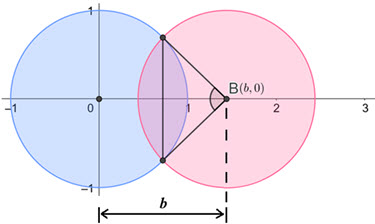 (a) Show that \(A\left( b \right)\) can be written as \(A\left( b \right) = 2{\cos ^{ - 1}}\left( {\frac{b}{2}} \right) - \frac{b}{2}\sqrt {4 - {b^2}} \)
(b) Evaluate \(A\left( 0 \right)\) and \(A\left( 2 \right)\).
(c) Show that \(\frac{{{\textrm{d}}A}}{{{\textrm{d}}b}} = - \sqrt {4 - {b^2}} \). [HL only]
(d) As the value of \(b\) increases from 0 to 2 the area of the overlapping region continually decreases. Find the exact value of \(b\) such that \(\frac{{{\textrm{d}}A}}{{{\textrm{d}}b}} = - 1\).
 Twitter
 Facebook
 LinkedIn