
 IB Docs (2) Team

P.o.t.W. #5 Solution
Problem of the Week #5 (2 January 2020)
SOLUTION
total area of shape \( = 2 + 2\int_0^1 {\left( {1 - {x^2}} \right)dx = 2 + 2\left[ {x - \frac{1}{3}{x^3}} \right]} _0^1 = 2 + 2\left[ {\left( {1 - \frac{1}{3}} \right) - 0} \right] = 2 + \frac{4}{3} = \frac{{10}}{3}\)
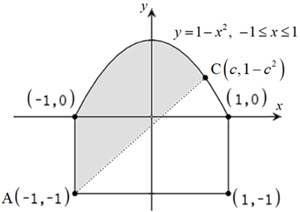 thus, the area of the shaded region in the figure below needs to be \(\frac{5}{3}\)
find equation of the line passing through the points A and C:
gradient of AC \( = \frac{{\left( {1 - {c^2}} \right) - \left( { - 1} \right)}}{{c - \left( { - 1} \right)}} = \frac{{2 - {c^2}}}{{c + 1}}\)
gradient and point \(\left( { - 1,\; - 1} \right)\) in gradient-slope form of line:
\(y + 1 = \left( {\frac{{2 - {c^2}}}{{c + 1}}} \right)\left( {x + 1} \right)\)
\(y = \left( {\frac{{2 - {c^2}}}{{c + 1}}} \right)x + \frac{{2 - {c^2}}}{{c + 1}} - \frac{{c + 1}}{{c + 1}}\)
equation of line AC is \(y = \left( {\frac{{2 - {c^2}}}{{c + 1}}} \right)x + \frac{{1 - c - {c^2}}}{{c + 1}}\)
area of shaded region \( = \int_{ - 1}^c {\left[ {\left( {1 - {x^2}} \right) - \left( {\frac{{2 - {c^2}}}{{c + 1}}x + \frac{{1 - c - {c^2}}}{{c + 1}}} \right)} \right]} \,dx = \frac{5}{3}\)
solve for c:
\(\int_{ - 1}^c {\left[ { - {x^2} + \frac{{{c^2} - 2}}{{c + 1}}x + \frac{{{c^2} + c - 1}}{{c + 1}} + \frac{{c + 1}}{{c + 1}}} \right]} \,dx = \frac{5}{3}\)
\(\int_{ - 1}^c {\left[ { - {x^2} + \frac{{{c^2} - 2}}{{c + 1}}x + \frac{{{c^2} + 2c}}{{c + 1}}} \right]} \,dx = \frac{5}{3}\)
\(\left[ { - \frac{1}{3}{x^3} + \frac{{{c^2} - 2}}{{2\left( {c + 1} \right)}}{x^2} + \frac{{{c^2} + 2c}}{{c + 1}}x} \right]_{ - 1}^c = \frac{5}{3}\)
\(\left( { - \frac{1}{3}{c^3} + \frac{{{c^4} - 2{c^2}}}{{2\left( {c + 1} \right)}} + \frac{{{c^3} + 2{c^2}}}{{c + 1}}} \right) - \left( {\frac{1}{3} + \frac{{{c^2} - 2}}{{2\left( {c + 1} \right)}} + \frac{{ - \,{c^2} - 2c}}{{c + 1}}} \right) - \frac{5}{3} \cdot \frac{{2\left( {c + 1} \right)}}{{2\left( {c + 1} \right)}} = 0\)
\(\frac{{ - \,{c^3} - 1}}{3} \cdot \frac{{2\left( {c + 1} \right)}}{{2\left( {c + 1} \right)}} + \frac{{{c^4} - 2{c^2} - {c^2} + 2}}{{2\left( {c + 1} \right)}} \cdot \frac{3}{3} + \frac{{{c^3} + 2{c^2} + {c^2} + 2c}}{{c + 1}} \cdot \frac{6}{6} - \frac{{10c + 10}}{{6\left( {c + 1} \right)}} = 0\)
\(\frac{{ - 2{c^4} - 2{c^3} - 2c - 2}}{{6\left( {c + 1} \right)}} + \frac{{3{c^4} - 9{c^2} + 6}}{{6\left( {c + 1} \right)}} + \frac{{6{c^3} + 18{c^2} + 12c}}{{6\left( {c + 1} \right)}} + \frac{{ - 10c - 10}}{{6\left( {c + 1} \right)}} = 0\)
\(\frac{{ - 2{c^4} + 3{c^4} - 2{c^3} + 6{c^3} - 9{c^2} + 18{c^2} - 2c + 12c - 10c - 2 + 6 - 10}}{{6\left( {c + 1} \right)}} = 0\)
\(\frac{{{c^4} + 4{c^3} + 9{c^2} - 6}}{{6\left( {c + 1} \right)}} = 0\;\;\; \Rightarrow \;\;\;{c^4} + 4{c^3} + 9{c^2} - 6 = 0\)
Is it possible to factorize \({c^4} + 4{c^3} + 9{c^2} - 6\)? Use polynomial root finder on GDC.

\({c^4} + 4{c^3} + 9{c^2} - 6\) has two real roots \(c = - 1\) and \(c \approx 0.698885...\)
Thus, \(c + 1\) is a factor of \({c^4} + 4{c^3} + 9{c^2} - 6\). Now the quartic polynomial can be written as the product of the linear factor \(c + 1\) and an unknown cubic factor as follows
\({c^4} + 4{c^3} + 9{c^2} - 6 = \left( {c + 1} \right)\left( {{a_3}{c^3} + {a_2}{c^2} + {a_1}c + {a_0}} \right)\) where \({a_3},{a_2},{a_1},{a_0}\) are real constants
Clearly, \({a_3} = 1\) and \({a_0} = - \,6\). Now find values of \({a_2}\) and \({a_1}\).
\({c^4} + 4{c^3} + 9{c^2} - 6 = \left( {c + 1} \right)\left( {{c^3} + {a_2}{c^2} + {a_1}c - 6} \right) = {c^4} + {a_2}{c^3} + {c^3} + {a_1}{c^2} + {a_2}{c^2} - 6c + {a_1}c - 6\)
\( = {c^4} + \left( {{a_2} + 1} \right){c^3} + \left( {{a_1} + {a_2}} \right){c^2} + \left( {{a_1} - 6} \right)c - 6\)
Thus, \({a_2} = 3\) and \({a_1} = 6\).
Hence, \({c^4} + 4{c^3} + 9{c^2} - 6 = \left( {c + 1} \right)\left( {{c^3} + 3{c^2} + 6c - 6} \right)\).
It follows that \({c^4} + 4{c^3} + 9{c^2} - 6 = 0\;\;\; \Rightarrow \;\;\;\left( {c + 1} \right)\left( {{c^3} + 3{c^2} + 6c - 6} \right) = 0\) and clearly \(c \ne - 1\)
The cubic equation \({c^3} + 3{c^2} + 6c - 6 = 0\) has one real solution of \(c \approx 0.698885489846...\)
Therefore, this is the value of c such that the line segment AC from \({\textrm{A}}\left( { - 1,\; - 1} \right)\) to \({\textrm{C}}\left( {c,\;1 - {c^2}} \right)\) divides the shape into two regions of equal area. Q.E.D.
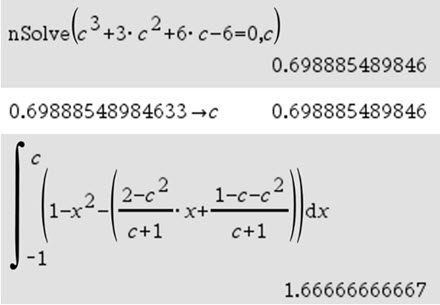
check answer on GDC
 Twitter
 Facebook
 LinkedIn